
Solar panels spread out over the surface of a lake somehow look futuristic. At first glance it almost seems unreal, like it’s a concept image ripped from a sci-fi documentary. But floating solar farms are no longer experimental ideas trapped in research papers. “They are entering the global renewable energy conversation in a very serious way.”
And with countries looking for cleaner energy, and feeling the squeeze on land, floating solar panels are starting to feel less like a novelty and more like a practical solution hiding in plain sight. Reservoirs, industrial ponds, water treatment plants and even abandoned mining pits are being converted into energy-producing spaces. Rather than fighting for prime land, these systems utilize surfaces that would otherwise be largely unused.
The idea seems simple enough. Put solar panels on the water, not the land. But the simplicity belies a rapidly growing market because it solves several problems at once. It produces renewable energy, reduces water evaporation and helps to optimize space efficiency in high-density areas, where land prices keep rising. The floating solar panels market is particularly interesting because of how creative the renewable energy space has become. People no longer just ask where to put solar panels. Even their definition of what constitutes usable energy infrastructure is being challenged.
Why Solar on Water Is Taking Off
Traditional solar farms need acres of land and that creates friction in many areas. Farmland is needed in agricultural regions. Urban areas have space constraints. Large scale land based solar projects also have problems with preservation and environmental issues of the forest.
Floating solar systems offer an alternative using existing water bodies. Reservoirs, irrigation ponds and industrial water basins suddenly become valuable energy assets, not unused surfaces. People overlook the big benefit of cooling efficiency. Water naturally helps to regulate heat, and solar panels tend to work better in cooler temperatures. In some conditions, floating panels can be more efficient than land-based systems because the surrounding water keeps the temperature more stable.
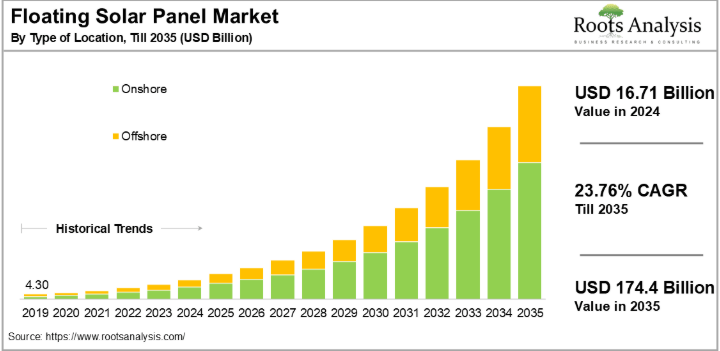
I came across Roots Analysis recently and they say, “The floating solar panels market size is projected to grow from USD 16.71 billion in 2024 to USD 174.4 billion by 2035, at a CAGR of 23.76% during the forecast period till 2035.” Those figures illustrate how rapidly governments and energy companies are starting to take this technology seriously.
Another surprisingly important factor is the conservation of water. The floating solar panels shade the surface of the water from direct sunlight, which helps to reduce evaporation. That’s a significant environmental and economic benefit in drought-prone areas. Floating solar is “doing two jobs with one piece of infrastructure,” one renewable energy consultant told me, and honestly that feels like a pretty good summary.
How Solar Power Works on Water
At their simplest, floating solar farms consist of photovoltaic panels mounted on floating platforms anchored to the bottom or the sides of bodies of water. These systems are meant to be stable, even when water levels, wind conditions and weather patterns change.
Generally the platforms themselves are made of durable, water-resistant materials that can withstand prolonged exposure to the environment. Floating systems are linked to nearby substations or grid infrastructure via electrical cables, so the electricity produced can be fed into the energy network.
Most floating solar projects to date are on calm inland water bodies and not in the ocean. Reservoirs, hydro‑electric dams, and waste‑water treatment ponds are particularly popular because of the proximity of existing utility infrastructure. One interesting trend is the growing integration of floating solar with hydropower facilities. Hydro plants are practical sites for hybrid renewable energy projects as they already have transmission connections and energy management systems.
Technology itself is still moving fast. Developers are testing stronger anchoring systems and more efficient panel layouts and using materials that can withstand harsher environmental conditions. The amazing thing is how flexible the idea is. Floating solar is no longer just small demonstration projects. Some installations now cover huge surfaces of water and generate large quantities of electricity.
Countries Leading the Market
Asia currently dominates much of the floating solar market, as many countries have increasing energy demand, coupled with a lack of available land. China has poured lots of money into floating solar infrastructure, including large projects built on flooded mining areas. India is also growing fast because of land pressure and ambitious renewable energy targets.
Geographic constraints and high population density helped make Japan one of the early adopters. Floating solar provided a way to add renewable capacity without robbing valuable land resources. Southeast Asia is emerging as an important region as well with many countries having plenty of reservoirs and good sunlight conditions for floating solar development.
Interest is also rising in Europe, especially in countries that are aggressively pursuing renewable energy expansion and carbon reduction goals. If you look at global projects, one thing that is clear is that floating solar tends to make the most sense where land is expensive, energy demand is rising and you already have water infrastructure close by.
Environmental Benefits and Concerns
There are a number of compelling environmental reasons for floating solar. Floating systems can also reduce water evaporation and possibly reduce algae growth by limiting sunlight penetration, as well as relieving pressure on land use.
As countries seek to reduce reliance on fossil fuels, cleaner energy generation is also part of the wider decarbonisation effort. But questions of the environment remain. Scientists are still investigating the potential long-term effect of large floating structures on aquatic ecosystems, oxygen levels in water, fish habitats and local biodiversity.
Depending on the project design and location, installation and maintenance activities could also affect water environments. “This balancing act of being innovative and yet responsible to the environment is becoming a big conversation in the market.” Renewable energy projects themselves still require careful ecological planning to avoid unintended consequences. “Green energy should not necessarily mean zero environmental impact,” one environmental researcher said. I think that view is important here.
Obstacles to Broader Adoption
Floating solar has great potential for growth but still has practical challenges. Installation costs are still relatively high compared to traditional land based solar farms. It is complex and expensive due to floating platforms, mooring systems and special engineering requirements.
It can also make maintenance harder. It is more difficult, from a logistical perspective, to inspect, repair and clean the water. There are other problems with extreme weather conditions, too. The changing water levels, storms, strong winds and exposure to the environment all require durable infrastructure that can withstand long-term stress.
In many countries, regulators are still figuring out how water rights, environmental permits, and energy policies apply to floating solar projects. And then there’s the public perception. Some communities are concerned about visual impact or ecological disruption, especially near recreational lakes or environmentally sensitive areas. Still, technological advances and the dropping costs of renewable energy continue to help in nudging the market forward at a steady clip.
The Future is Looking More and More Hybrid
One of the most interesting developments in the floating solar market is the emergence of hybrid renewable energy systems. Pairing hydropower plants with floating solar can help energy producers better balance electricity generation. Solar power can supplement hydropower in sunny conditions and existing grid infrastructure can cut development costs.
Some projects are also exploring the integration of battery storage, creating more stable renewable energy systems that can better accommodate fluctuations in supply and demand. Urban planners and industrial operators are taking note, too. Water treatment plants, industrial reservoirs and municipal water systems could be part of future renewable energy networks.
The wider renewable energy sector is gradually moving towards more integrated and space efficient solutions, and floating solar fits naturally in that direction.
Conclusion
The floating solar panels market is on the rise because it solves a number of contemporary energy issues all at once. It produces renewable electricity, saves land space, reduces water evaporation and creates new opportunities for the use of underutilized water surfaces.
Floating solar systems are of particular interest to countries with limited land or rising energy demand. However, technological improvements continue to make large scale projects more practical and cost effective. Installation costs, environmental impact and maintenance issues still need to be carefully considered. But the market’s momentum is still strong as governments and industries hunt for smarter renewable energy solutions.
What’s interesting about floating solar is it creates a different discussion in terms of infrastructure itself.” Water surfaces that once served only limited purposes are now playing an active role in producing clean energy. Such innovation may be more important than ever in a world that is becoming more and more sustainability and efficiency conscious.